


PRS 85/15 “S” Pickup Review – Fat PAF Character or Piece of Garbage

Updated: 3 days ago

In the world of electric guitars, certain pickups transcend their role as mere components and come to embody a brand’s entire tonal philosophy. The 85/15 series from PRS is a prime example. Named after the year Paul Reed Smith began building guitars (1985) and the year this vision was reimagined (2015), these pickups reflect a deliberate effort to reconcile heritage with modernity.
For decades, PRS has pursued a finely judged balance—never fully vintage, yet never overtly modern. That equilibrium lies at the heart of the 85/15 design. What makes the concept particularly compelling is its extension beyond the company’s Maryland-built instruments into the more accessible SE range. Enter the 85/15 “S” pickups: a set that not only carries the DNA of its American counterpart, but also raises a critical question—how much of that identity survives the transition to a more attainable platform?
In this review, i take a closer look at the 85/15 “S” set beyond the usual spec sheet analysis, focusing instead on feel, dynamic response, and real-world application. After all, some pickups reveal their true character not in numbers, but in the subtle dialogue between player and instrument.
The Test Guitar

PRS SE 85/15S I have still sits on my hand-made superstrat, “Goldie”, that has a Turkish alder body, a Q-sawn one-piece maple neck in a chunky Endur-Neck profile, Gotoh 510T-FE1 tremolo, 25.5” scale, steel frets, Bourns 500K volume and Alpha 500K tone pots, and 009-046 D'Addario NYXL0946 strings in E-standard tuning. The guitar has a Dimarzio Humbucker From Hell and custom wound middle (true single with coil tapping 5.5K/6.5K windings, now on 6.5K side is on) pickups. Its primary (unplugged) tone ranges from balanced to medium-bright.
Evaluation
Before diving into tones and performance, there’s something that needs to be addressed: identifying these pickups proved far more challenging than expected. And I’m not referring to tonal characterization—I’m talking about determining exactly which version I had in hand.
PRS SE 85/15 “S” pickups have appeared in multiple variations over the years, and tracing their identity through baseplate markings and subtle construction differences is anything but straightforward. While I’m confident I’ve reached a reasonably accurate conclusion, absolute certainty remains elusive within this segment of the SE lineup.
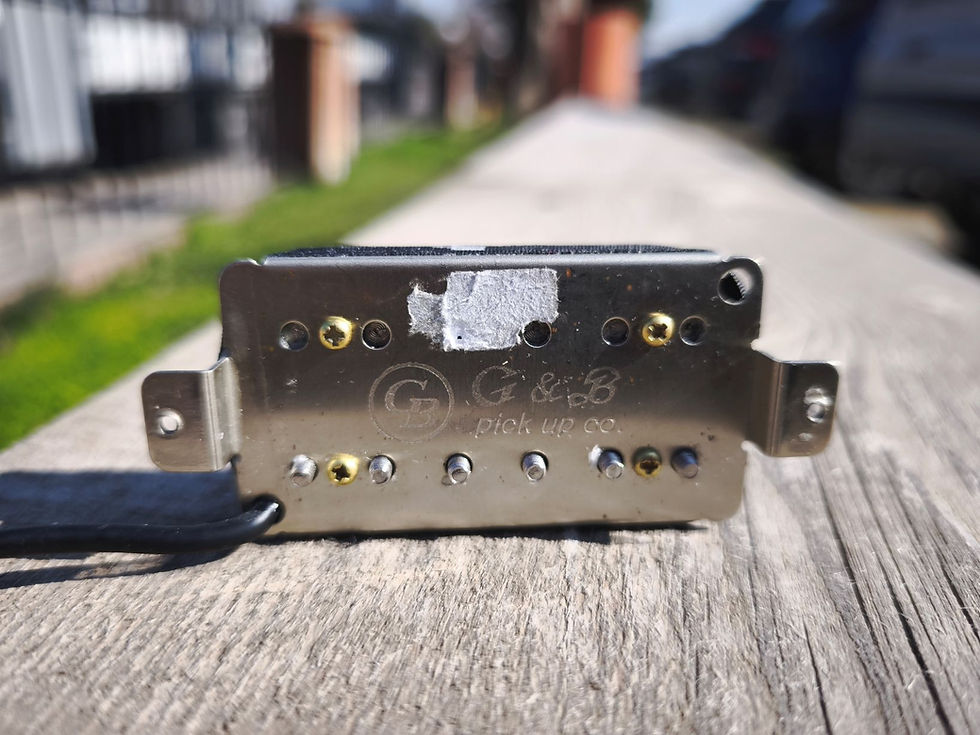
The set I examined features a nickel silver baseplate stamped with the G&B mark. Other versions are known to exist, including brass baseplate variants and what appear to be slightly lower-wind iterations—likely representing more recent production. This alone complicates any attempt to define a single, unified identity for the 85/15 “S.”
That said, these pickups have been on my radar for quite some time. Thanks to Emre Bingöl—a true ally of Tone Journey—I finally had the opportunity to spend meaningful time with them. I’m sincerely grateful to him for sending the set over for both measurement and evaluation.
After taking my initial readings, I chose—largely due to time constraints—to postpone testing the neck pickup for now. My primary interest has always been the bridge unit, which, at least on paper, seemed particularly compelling: a >9K “fat PAF”-leaning humbucker.
But does it truly deliver on that promise—or how close does it get?
…And, my measuremens are here;
PRS SE 85/15 S Bridge
Magnet – Alnico (Probably A2)
Advertised DCR: K Ohm (Series)
Measured DCR: 9.2770 K Ohm (Series)
Measured DCR: 4.6606 K Ohm (Screw Coil)
Measured DCR: 4.5912 K Ohm (Slug Coil)
Inductance @100Hz: 5.8075 H (Series), Q:0.3937
Inductance @100Hz: 2.4675 H (Screw Coil)
Inductance @100Hz: 2.4289 H (Slug Coil)
Measured C @100KHz: 110pF (Series)
Calculated Self Resonance Peak: 6.2855KHz
Calculated Loaded Res. Freq w/470pF: 2.7413KHz
Output: Low/Medium
EQ (B/M/T) –
Gauss: 300G screw(South), 310G slug (North) (measured at top center of D&G pole pieces)
Ambient Measurement Temperature: 21oC
PRS SE 85/15 S Neck
Magnet – Alnico (Probably A2)
Advertised DCR: K Ohm (Series)
Measured DCR: 8.3760 K Ohm (Series)
Measured DCR: 4.2211 K Ohm (Screw Coil)
Measured DCR: 4.1162 K Ohm (Slug Coil)
Inductance @100Hz: 5.0266 H (Series), Q:03772
Inductance @100Hz: 2.1821 H (Screw Coil)
Inductance @100Hz: 2.1004 H (Slug Coil)
Measured C @100KHz: 116pF (Series)
Calculated Self Resonance Peak: 6.5882KHz
Calculated Loaded Res. Freq w/470pF: 2.9208KHz
Output:
EQ (B/M/T) –
Gauss: 290G screw(South), 300G slug (North) (measured at top center of D&G pole pieces)

As is well known—or easily observed from the baseplate markings—the pickups are manufactured by G&B. Founded in 1999, G&B is a well-established Korean company with a long track record in OEM production. Over the years, they have been responsible for manufacturing pickups for major guitar brands such as Epiphone and PRS, as well as the HZ series for EMG. By unit volume, they are also often cited as one of the largest pickup manufacturers in the world.
This particular set marks my first hands-on experience with a G&B product for review purposes. While the design itself may belong to PRS, from a manufacturing standpoint everything appears to be in its right place. Fit, finish, and overall execution point to a well-made product that fulfills its role as an electric guitar pickup with confidence. It’s a solid first impression—and certainly leaves me curious to explore more of G&B’s work in the future.
After taking my measurements, I had a strong suspicion that the neck pickup might lean toward a slightly muddy character. Combined with time constraints—as mentioned earlier—I ultimately decided to pass on testing it for now. That said, I’ll still include its visuals here to fulfill the archival side of this review.
PRS SE 85/15 S Neck PRS SE 85/15 S Neck PRS SE 85/15 S Neck PRS SE 85/15 S Neck PRS SE 85/15 S Neck PRS SE 85/15 S Neck
Interestingly, on paper the neck unit appears quite usable in the bridge position as well. Given that the string spacing is identical between neck and bridge in this set, it’s a detail worth noting for those who like to experiment with unconventional configurations. From this point forward, the focus will remain on the bridge pickup.
At first glance, the pickup follows a fairly traditional humbucker architecture. However, there are some notable details. The pole screws are shorter than what you’d typically find on classic PAF-style clones. This results in a slightly higher magnetic flux concentration at the pole piece tips, which can subtly influence attack and string definition. According to PRS’s official notes, the magnet is simply listed as “Alnico,” without further specification. My educated guess leans toward Alnico II. This assumption is based on a combination of slightly elevated inductance values and a measured gauss strength that aligns closely with a strong A2 magnet. To my ears, the tonal response also supports this hypothesis—but I’ll get into that in more detail later. Since the pickup is on loan, I wasn’t able to disassemble it for a deeper inspection. As a result, details such as magnet dimensions or wax potting status remain unknown.
One aspect that did catch my attention, however, was the level of oxidation on both the baseplate and the pole screws. I have pickups in my collection that are significantly older, and I regularly come across many more in various conditions. In that context, the degree of oxidation here felt somewhat excessive for a unit that is likely only a few years old. Of course, without knowing the environmental conditions it has been exposed to, this remains an observation rather than a definitive criticism—but it’s worth mentioning nonetheless.
So what drew me to this pickup in the first place? Simply put, overwound PAF-style humbuckers in the 9–10K DCR range have long been a particular area of interest for me. With the right magnet choice, these pickups tend to occupy a very appealing middle ground: fat, yet not overly saturated; responsive, yet not compressed to the point of choking the note. Compared to higher-output “hot rod” designs, they often feel more open, more dynamic, and notably more sensitive to volume pot adjustments.
By contrast, more traditional PAF bridge pickups—typically measuring around 8–8.5K DCR and under 5H of inductance—can come across as a bit too bright or thin for my taste, especially in 25.5" scale guitars. This is less of an issue in shorter-scale instruments like Gibson Les Paul-style guitars, where the inherent tonal weight tends to balance things out, particularly in the fuller-sounding examples.
As I came across various measurements and user reports regarding the DCR and inductance values of PRS’s 85/15 “S” models, they naturally found their way onto my radar. That said, given the variation between different versions and the inconsistency of data available online, forming a definitive expectation beforehand wasn’t exactly straightforward.

Moving on to tone…
Before anything else, it’s important to note the context: the pickup I removed just prior to installing this one was the DiMarzio Air Zone. So this was a direct, back-to-back comparison. Interestingly, the “cocked wah” character I associate with the Air Zone was very much present here as well.
In terms of EQ, this immediately leads me to a point where I strongly disagree with some of the official descriptions and user impressions I’ve come across—namely, the idea that this pickup is “mid-scooped.” That simply wasn’t my experience. Quite the opposite: I hear a pronounced midrange presence, with a particularly strong emphasis in the low mids. There’s a clear “mid hump,” an audible sense of oomph that defines the core of the tone.
The low end feels somewhat spongy, which further reinforces my suspicion of an Alnico II magnet. If you’re familiar with—and enjoy—the character of pickups like the Seymour Duncan Custom Custom or the DiMarzio Tone Zone, there’s a good chance this PRS model will resonate with you as well.
Highs are rounded rather than sharp, with much of the perceived presence sitting in the high-mid range. I’ve encountered a similar feel before in the Lollar Imperial High Wind, and there’s definitely some overlap in character here.

In terms of clarity, this isn’t an exceptionally articulate pickup—but that’s hardly a surprise. As mentioned earlier, I wasn’t expecting the kind of note separation you’d get from a lower-wind, ~8K PAF-style bridge pickup. This is a different animal altogether.
About compression feeling. Yep, everything went just as i had expected. At full volume, yes, it has its kind of compression just as i liked. If durn the volume pot down, then you will hear the clarity come back and achieve a clearer tone again.
Again, if you’re comfortable with the tonal territory of the Custom Custom or Tone Zone, you’ll likely feel at home here. That said, there are notable differences. It doesn’t quite reach the output level or the “in-your-face” immediacy of a Tone Zone. However, it retains a similar midrange “honk,” while offering a more controlled and breathable response.
If this pickup were mine, I’d be very tempted to experiment with magnet swaps—perhaps moving toward an Alnico IV or a slightly degaussed Alnico V—to bring the inductance down a touch, rein in the mids, and achieve a flatter overall EQ.
As for guitar pairing, this pickup seems particularly well-suited to brighter instruments—Strats, superstrats, and similar platforms where that midrange push can be put to good use. How well it works will ultimately depend on how much midrange you’re looking for. In a darker, thicker-sounding Gibson Les Paul, I’d personally think twice. Not a deal-breaker, but definitely something to consider carefully.

Pairing-wise, I had surprisingly good results with the DiMarzio Humbucker from Hell in the neck position. Despite their contrasting EQ profiles, they formed a balanced and musically usable combination. I’d also expect strong compatibility with models like the DiMarzio PAF and the DiMarzio Bluesbucker.
The DiMarzio PAF Pro, however, might present an output mismatch—though I’d want to test that to be certain. From the Seymour Duncan side, the Pearly Gates (neck), Alnico II Pro, and ’59 all come to mind as strong candidates. I’d also expect the Tonerider Rocksong neck to pair very well with this bridge unit.
Cleans? Pretty nice and sweet. I am the right expert to say solid words about it but i could achieved typical sweet clean tones in the favour of Slash, Duane Allman, Lynyrd Skynyrd etc. The clean tones of the guys played Les Pauls…
Conclusion
The PRS SE 85/15 “S” bridge pickup ultimately lands in a very specific—and rather compelling—tonal space. It’s not a traditional PAF, nor is it a full-blown modern high-output design. Instead, it sits comfortably in between: an overwound, mid-forward humbucker that prioritizes body, feel, and control over sheer aggression.
What stands out most is its midrange character. Despite some claims of a scooped EQ, this pickup delivers a pronounced low-mid push with a rounded top end and a slightly spongy low response—traits that strongly suggest an Alnico II-style behavior. The result is a tone that feels thick and vocal, yet more restrained and breathable than many high-output alternatives.
It won’t satisfy players looking for razor-sharp articulation or ultra-tight low end, and in darker guitars it may require careful consideration. However, in brighter platforms, it can add exactly the kind of weight and character that many players find missing.
In many ways, the 85/15 “S” bridge is less about impressing on first strike and more about long-term usability. It doesn’t overwhelm—it integrates. And for players who appreciate that balance, it can be a surprisingly rewarding pickup.
Pros ✅
· Strong, musical low-mid presence
· Fat yet controlled hot PAF-style output
· Dynamic and touch-sensitive
· Smooth, rounded highs
· Versatile with many neck pickups
· Great for bright guitars (Strat, superstrat)
Cons ❌
· Less clarity than low-wind PAFs
· Can feel “too warm” in darker guitars
· Clarity issues can happen
· Lower output than Tone Zone-style humbuckers
· Version variations may confuse buyers
· Limited official specs
Please feel free to subscribe my blog & follow my socials. So that you can support me;
Guitar pickup reviews


Thanks for the review. In prs se guirars the bridge sounds normal to me, but not fantastic. Interested in your opinion about neck. For my taste it leans to be dull and flat. Still normal, but not impressive.