


Duncan Designed HB-103B Review | The Most Underrated OEM Metal Humbucker?

Updated: Sep 15
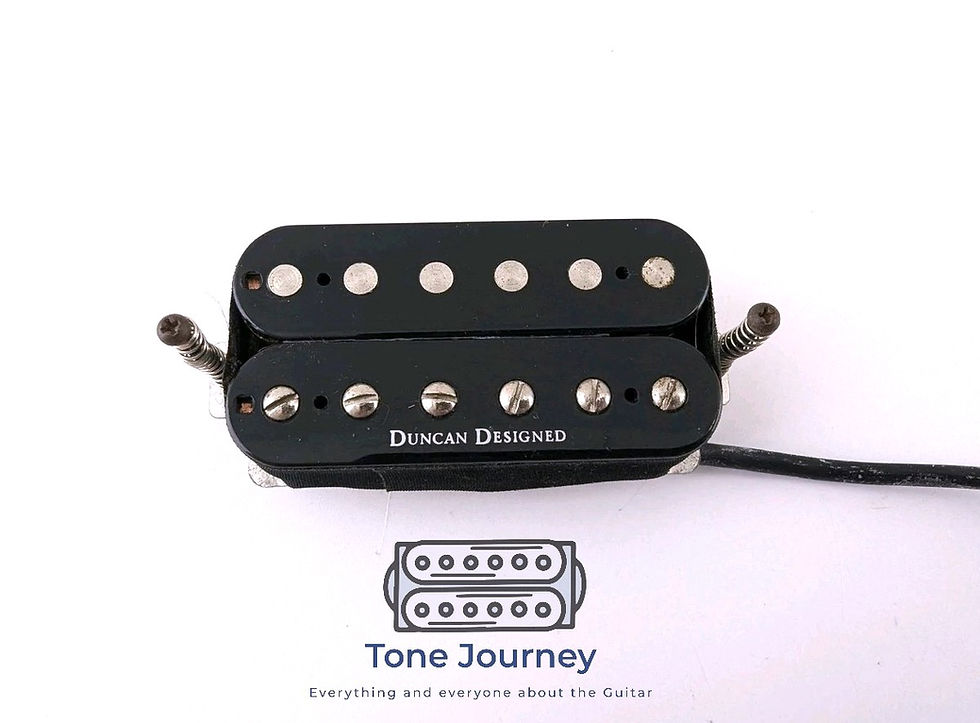
In the world of guitars, there are certain pieces of gear that almost everyone recognizes by name, yet finding accurate information about them can be surprisingly difficult. Seymour Duncan's Duncan Designed series, supplied as OEM equipment to various manufacturers for many years, falls squarely into that category. Some players see them as nothing more than budget pickups with a different logo, while others regard them as remarkably capable alternatives to their Seymour Duncan counterparts.
The truth, as is often the case, lies somewhere in between.
A quick search through guitar forums and social media groups will reveal countless opinions about the Duncan Designed HB-103B. Some players describe it as a direct clone of the SH-6 Duncan Distortion, while others insist that the two have very little in common. One reason for these conflicting views is that the HB-103B was produced as an OEM pickup for many years, often by different manufacturers, while very little reliable technical information was ever made publicly available. So what is the HB-103B really all about? Does its high-output ceramic design, tonal character, and playing feel still make it a worthwhile choice today? Or is it simply another stock OEM pickup that deserves to be replaced at the first opportunity?
In this review, I'll take a closer look at the HB-103B from both technical and practical perspectives, examining its construction, tonal characteristics, and overall performance.
Test Guitar
I have been using that pickupon my Jackson Soloist SLX DX. You can check my detailed review here.
Evaluation
Official desciption about DD line from 2016 website

“The Duncan Designed line of pickups was started in 1995 at the request of several of our larger original equipment manufacturer (“OEM”) customers who wanted to offer a pickup tied in to the Duncan identity on their mid-level instruments. While USA-made Seymour Duncan and Basslines pickups are intended to fit on instruments with list prices over US$800, the Korean-built Duncan Designed pickups are intended for OEM use on guitars and basses with retail prices between US$300 and $800. The Duncan Designed club members include Squier, Jackson, ESP LTD, Schecter Diamond Series, Daisy Rock, Hamer, Aria Pro II and Samick’s Greg Bennett series.
There are currently several humbuckers available in the Duncan Designed range, each of which is neck or bridge position-calibrated and was modeled after a USA-built model..”
How about HB-103 line? Here it is;
“The HB-103 was patterned after the SH-6 Duncan Distortion set. It uses ceramic magnets and powerful coil windings to deliver a high output tone with lots of crunch and harmonics. The bridge pickup is Trembucker-spaced”
Want to see the measurements, right here!
Duncan Designed HB-103B
Magnet – Ceramic
Measured DCR: 17.364 K Ohm (Series)
Measured DCR: 8.601 K Ohm (Screw Coil)
Measured DCR: 8.730 K Ohm (Slug Coil)
Inductance @100Hz: 8.020 H (Series), Q:0.2901
Measured C@100KHz: 170pF
Calculated Self Resonance Peak: 4.3103KHz
Calculated Loaded Res. Freq w/470pF: 2.2215KHz
Output: High
EQ (B/M/T) –
Gauss: 370G screws, 440G slug (measured at top center of D&G pole pieces)
Ambient Measurement Temperature: 27C
Before diving into the HB-103B itself, it's worth taking a quick look at the Duncan Designed lineup as a whole. Contrary to popular belief, Duncan Designed wasn't just a random collection of budget OEM pickups. The series was deliberately organized so that most models were inspired by established Seymour Duncan designs, each targeting a specific tonal profile. The official info about them is below:
“There are currently several humbuckers available in the Duncan Designed range, each of which is neck or bridge position-calibrated and was modeled after a USA-built model.
The HB-101 was patterned after the Seymour Duncan SH-1 '59 Model humbucker set. It uses an Alnico 5 magnet and winding spec based on the revered 1955 - 1960 Gibson P.A.F.
The HB-102 was modeled after Seymour's favorite humbucker combination, the USA-made SH-4 JB bridge and SH-2n Jazz Model neck set. Like the HB-101s, these pickups also use Alnico 5 magnets, but have a hotter winding spec, based on the world's most popular "hot-rodded" humbucker. The bridge pickup is Trembucker-spaced.
The HB-7 is a seven-string version of the HB-102 set.
The HB-103 was patterned after the SH-6 Duncan Distortion set. It uses ceramic magnets and powerful coil windings to deliver a high output tone with lots of crunch and harmonics. The bridge pickup is Trembucker-spaced.
The HB-104 is a high-output blade humbucker that's based on a design we created for England's Patrick Eggle Guitars. The guitar was short-lived, but the pickup lives on in some recent guitar designs from Schecter and Jackson.
The HB-108 is called the Detonator and is based on the high-output, Seymour Duncan SH-8 Invader.
The P90-1 is a stacked-coil P-90 that offers series, parallel and out-of-phase switching capabilities.
The SC-101single coils represent a tonal cross between Seymour Duncan's SSL-2 Vintage Flat and SSL-6 Custom Flat models. Unlike many inexpensive single coils that have a large ceramic magnet glued underneath non-magnetic steel slugs, the SC-101s use real Alnico V rod pole pieces with a flat magnet stagger for exceptional string balance. The three single coil models are each specially calibrated to either bridge, middle or neck positions, with the middle pickup reverse wound, reverse polarity. The tone is chimey and bright with exceptional "quack" in the notch positions.
The HR-101 is based on the popular Seymour Duncan SHR-1 Hot Rails, but with increased output.
The LS-101 is a Lipstick Tube design pickup.
There are also on-board electronics for bass and guitar.
The GEQ-1 Firestorm™ 20dB gain boost circuit for solid body electrics takes a standard looking axe and, with the flick of an innocent looking mini-toggle switch, turns it into a weapon of mass destruction.
For bass, there are two circuits, the BEQ-2 two-band and the BEQ-3 three-band.
In addition, there are numerous offerings for bass in standard Jazz Bass, P-Bass, soapbar and Music Man formats.”
There are certain guitar pickups that have reached an enormous number of players—yet opinions about them couldn't be more divided. As I mentioned in my DiMarzio/IBZ review, I like to call these the "everyone knows them, but nobody really knows them" pickups. The DiMarzio/IBZ series certainly belongs in this category. So do the Ibanez V7 and V8 or V1/V2 humbuckers. Jackson's J-50 and J-90 models fit the description as well. Unlimited roumors but almost none measurements to prove if they suck or rock. And, of course, the Duncan Designed series is no exception. I’ll collect, discover and write more reviews about those pickups in the future.
Another view should be added here by Evan Skopp (former vice president of SD at that time) once said about those Duncan Designed pickups:
“Duncan Designed pickups and Duncan Performer pickups are genuine Duncans, I can assure you. They're just not built in the same Santa Barbara factory that makes Seymour Duncan, Basslines, Antiquity, and Benedetto pickups.
Furthermore, you can put Duncan Designed pickups up against many (non-Seymour Duncan) USA-made pickups and the Duncan Designed pickups will come out on top. The humbuckers largely use Alnico magnets, polycarbonate bobbins, high-quality hookup cable. The single-coils uses Alnico pole piece magnets. The active HB-105 humbuckers use balanced inputs going into a differential preamp and will reduce noise and hum more effectively than other (non-Seymour Duncan) USA-made active pickups.
Yes, they're made in Korea. But that doesn't necessarily mean they are anything less than genuine Duncans. They're just not "Seymour Duncans."
Anyway, let's start evaluating the pickup itself. As usual, I'll begin with first impressions and its physical construction.
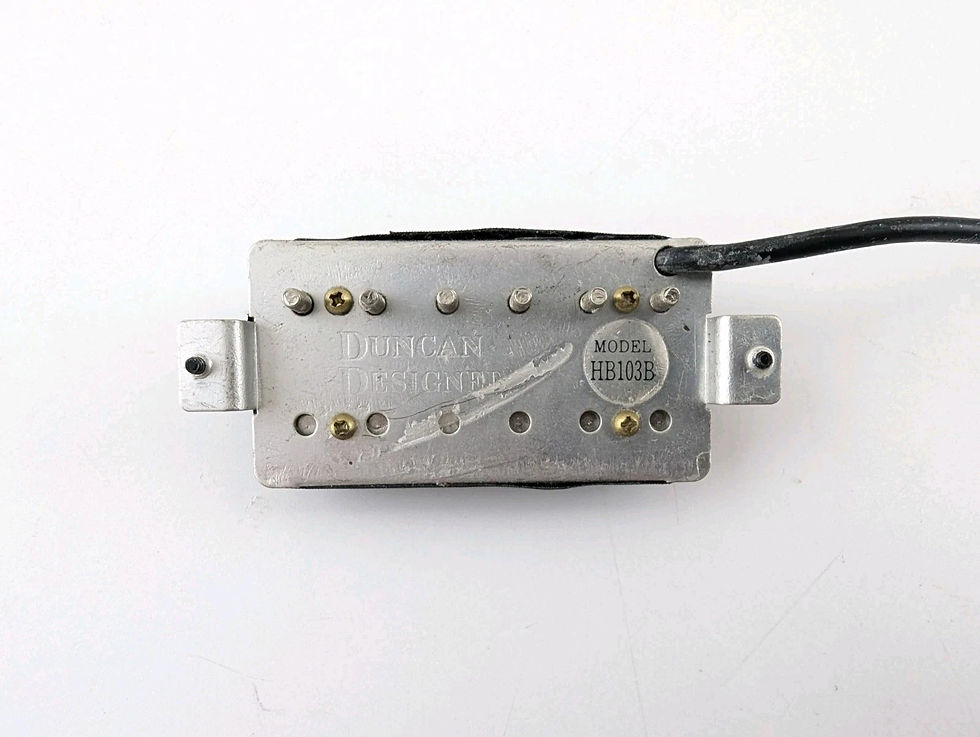
Fortunately, this part can be summed up rather quickly. Like many Duncan humbuckers I've examined over the years, the HB-103B follows a fairly conventional recipe: short legs, a nickel silver baseplate, standard-length pole screws, and all the hallmarks of a typical full-size humbucker. Even the bobbin material appears to be either identical or at least very similar to what Seymour Duncan uses on its U.S. made pickups.
The coil wire is most likely poly-insulated, just like the JB and Duncan Distortion, although I didn't completely disassemble the pickup to verify every detail. The magnet is ceramic, as expected. While I didn't remove it from the assembly, judging by the pickup's overall height, it appears to be roughly the thickness of a standard Alnico bar magnet—or something very close to it. In other words, this isn't one of those designs that relies on an oversized ceramic magnet like the DiMarzio Super Distortion or the Seymour Duncan Black Winter.
I measured the pickup's magnetic flux density at approximately 350–450 gauss, which further supports my assumption that it uses a relatively thin ceramic magnet. Admittedly, these are values I've also encountered in some humbuckers equipped with particularly strong Alnico V magnets, so the measurement alone isn't definitive. Still, when considered alongside the pickup's overall construction, a standard-thickness ceramic magnet seems the most likely scenario.
Both the overall DC resistance and the individual coil resistances closely match what I'd expect from a JB-style winding pattern and are consistent with the original Duncan Distortion. As expected, the inductance is slightly lower than the JB pickups I've measured over the years.
The most interesting finding, however, was the pickup's relatively high capacitance, despite being an uncovered humbucker. My assumption is that this shifts the pickup's resonant frequency slightly toward the upper-midrange while gently smoothing off some of the extreme high end.

Unfortunately, I don't currently have a Seymour Duncan Distortion on hand for a direct A/B comparison. However, my longest experience with one was in a Charvel So-Cal Pro-Mod tuned to standard pitch. I remember it sounding somewhat brighter, a bit of piercing. Not harsh or overly trebly—that's not what I mean—but bright enough that I felt it would probably shine even more in a naturally darker-sounding guitar. Interestingly, I never got that impression from the HB-103B. I'm fairly confident that my lower tuning plays a significant role here. To be honest, I was simply too lazy to spend an hour readjusting the Floyd Rose just to bring the guitar back to standard tuning for a proper comparison :)
So, what does the official description say?
"It uses ceramic magnets and powerful coil windings to deliver a high output tone with lots of crunch and harmonics."
Well... I have a couple of comments.
First, based on my gauss measurements, I seriously doubt there's any such thing as ceramic magnets—plural—in there. Unless I missed something, this appears to be a fairly conventional humbucker with a single ceramic bar magnet, just like countless others. So that part of the description is, at best, a rather odd choice of wording.
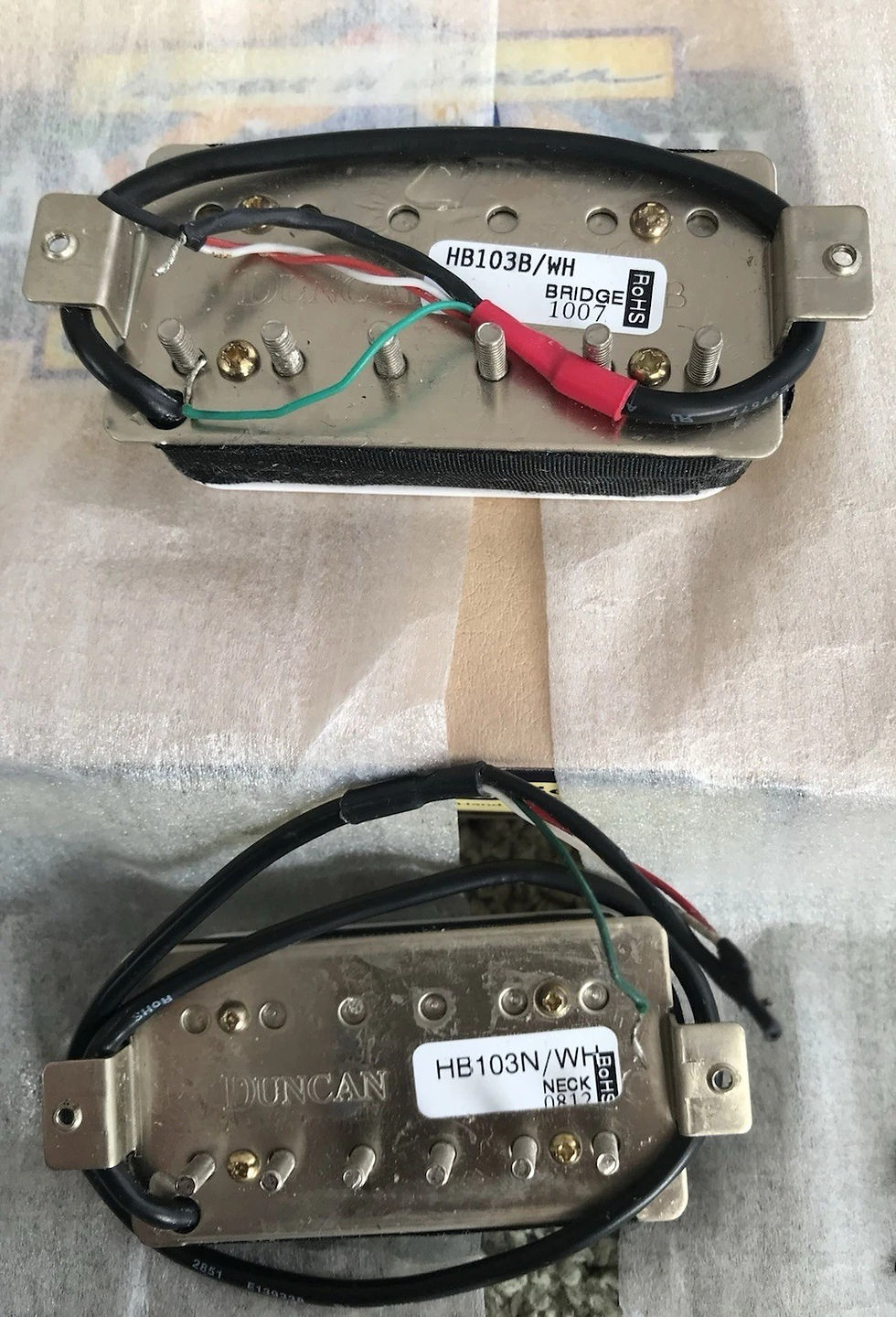
The second part is even more amusing: "powerful coil windings." What exactly is that supposed to mean? "Tighter winding"? Sure, that would at least be a meaningful technical statement and could even help explain the relatively high capacitance I measured. But powerful windings? Windings aren't "powerful"—they have a turn count, wire gauge, resistance, inductance, capacitance, and winding tension. Calling them powerful tells us absolutely nothing from an engineering standpoint. That's marketing copy doing what marketing copy does, I suppose. It sounds impressive, but what the heck, man!
Now, let's get to what really matters: the tone. From an EQ standpoint, the HB-103B delivers a tight and well-defined low end, although I wouldn't describe it as particularly rich or abundant. The mids, on the other hand, are capable of making the overall tone sound surprisingly thick and full, while the highs have enough presence to become downright ear-piercing if the rest of your rig leans in that direction.
The Seymour Duncan Distortion has traditionally been rated at 5-6-8 for Bass, Midrange, and Treble. If I had to assign numbers to the HB-103B in front of me, I'd probably call it 5-6-6.5.
That said, I want to be careful here. I don't have a Duncan Distortion on hand, nor have I been able to find a set of reliable electrical measurements for one. The last time I spent any meaningful amount of time with a Distortion was years ago, and I'd rather not pretend I can make a trustworthy A/B comparison based on a 45- or 50-minute playing session from memory. There's simply too much room for bias.
Still, if memory serves me right, I do remember the Duncan Distortion's top end being a little more lively and richer than what I'm hearing from the HB-103B. Even so, the HB-103B still strikes me as a clearer-sounding than the JB.
My favorite aspect of the HB-103B is its response during palm-muted passages, fast-picked runs, and aggressive rhythm playing. This is where the pickup really comes alive. There are times when I drift away from heavily overwound pickups because of their reduced dynamic response. They can sometimes feel a little compressed or less expressive under the fingers. But every now and then, when it comes to high-gain rhythm tones, they remind me exactly why they have such a loyal following. I had a similar experience with the Black Winter, and I can honestly say the HB-103B gave me the same kind of enjoyment. There's something deeply satisfying about the way it attacks a riff—it feels immediate, confident, and unapologetically aggressive without turning into an undefined wall of gain.
So, should you replace this pickup just because it came stock in your guitar? I never felt the need. Period. In fact, if you happen to find an HB-103B for a good price on the used market, I'd strongly recommend picking it up. At worst, it'll sit in your parts drawer waiting for the right project. At best, you may discover that this overlooked OEM pickup delivers exactly the kind of high-gain rhythm tone you've been looking for.

What styles of music is it best suited for? Metal, without a doubt. I'd put virtually every subgenre of metal at the top of the list. From the polished tones of '80s hair bands to the savage sounds of Scandinavian extreme metal, from melodic death metal to the raw, punk-infused territories, the HB-103B feels right at home in heavy music. As long as you're not chasing an oversized, earth-shaking low end, this pickup has everything you need. It stays articulate under high gain, cuts through a mix with ease, and delivers the kind of aggressive attack that makes fast riffs and tight rhythm work incredibly satisfying.
Clean tones? Do you like the cleans of most metal bands? There you go! ;)
Conclusion
The Duncan Designed HB-103B isn't a "poor man's Duncan Distortion," nor is it merely a generic OEM pickup with a famous logo stamped on it. It's a well-engineered high-output humbucker that clearly takes inspiration from the SH-6 while developing a personality of its own.
Its greatest strengths lie in aggressive rhythm playing, tight palm-muted riffs, and the ability to remain articulate under high gain. While it may not offer the huge low end or the lively top-end sparkle of some modern high-output designs, it compensates with a thick midrange, excellent note definition, and a surprisingly refined overall voice.
More importantly, the HB-103B proves that not every stock pickup deserves to be replaced simply because it's a stock pickup. If anything, this review reminded me how many overlooked OEM pickups are still waiting to be rediscovered.
If you come across one at a reasonable price, don't dismiss it. You might end up with one of the best bargains in the used pickup market.
Pros
· Excellent response for palm-muted riffs and fast alternate picking
· Thick, musical midrange that helps riffs cut through a mix
· Clear note separation despite its high output
· Tight, controlled bass response
· Well-built construction with quality materials for that price
· Affordable to reach from the used market
· No compelling reason to replace it simply because it's a stock pickup
Cons
· Bass response isn't particularly huge or "modern"
· Less dynamic than medium-output humbuckers
· High end can become aggressive in naturally bright guitars
· Doesn't have quite the lively top end of the Seymour Duncan Distortion
· Clean tones are perfectly usable (for vintage tone seekers) but clearly not its primary focus
Please feel free to subscribe my blog & follow my socials. So that you can support me;
Guitar pickup reviews


Comments