


DiMarzio X2N Review DP102 – The Ultimate High-Output Humbucker?

Updated: Sep 27

Despite being, without a doubt, one of the most popular aftermarket pickups in my country, the DiMarzio X2N was also one of the pickups I kept at arm’s length for a looooong time. And, as you might expect, I have two main reasons for that. The first is simply that I have never really needed an extremely high-output pickup. Once the master volume knob became a standard feature on guitar amplifiers, the need for progressively hotter and hotter pickups to get progressively heavier tones more or less disappeared. I can completely understand why this made sense in the single-knob era, but in the modern guitar world, I find more versatile pickups much more logical and useful. So, until now, I never really felt the need for a pickup with an output this high.
The second reason is actually a musician I love and deeply respect: Chuck Schuldiner. I absolutely love Death. I’m a huge fan of Symbolic, and I also adore Leprosy and The Sound of Perseverance. The songwriting, the arrangements, the riffs... they’re all insane. But despite my admiration for Chuck as a musician, I never really liked his live tone. When I watched Death – Live at Dynamo back in the late 1990s, I found Chuck’s tone extremely raw and, frankly, far too piercing for my taste. The X2N sitting on his B.C. Rich naturally kept me away from the pickup for years.
But now, all these years later, and partly thanks to some of Paul Gilbert’s more recent recordings, my prejudices have slowly given way to curiosity. And so, here I am, finally reviewing the DiMarzio X2N—a pickup I spent many years deliberately avoiding…
Test Guitar

X2N still standing on my “Pink Tiger” for a while. That pink tiger is a superstrat has a Jackson Dinky body made of alder, one piece maple neck in modern C profile, German made Jackson Floyd Rose tremolo with Japanese stainless steel saddles, 25,5” scale, stainless steel frets, Alpha 500K pots and elixir strings in half step down tuning. Guitar has Seymour Duncan ‘59 in the neck and No-name blade style middle pickup (~9K thou). Its primary (unplugged) tone is neutral to fairly bright.
Evaluation
Official desciption from early 80s was like this;
“Loud, crunching rock pickup w/ lots of harmonic overtones” and in 97 it says; “Very high output voltage across a wide frequency range”
97 catalog also says:
“The X2N is a take-no-prisoners, in-your-face humbucker. Twin, wide-bar pole pieces give the X2N a nasty, dangerous look; and rightly so. Our highest gain pickup excels at thrashing your amplifier into screaming overdrive. Put one in the bridge position for a powerful boost in the voltage the amp sees from your guitar. The result is a hot sound with relentless drive. If your amp needs to see more gain in order to go over the top in the overdrive department, the X2N’s output and EQ are focussed to slam the signal through with authority.
Not that the X2N is completely single-minded: 4-conductor wiring permits single-coil and parallel humbucking operation for a wide selection of hot, musical sounds.”
Official desciption today is;
“The X2N is a “take-no-prisoners, in-your-face” humbucker. Twin, wide-bar pole pieces give the X2N a nasty, dangerous look — and rightly so. Our highest gain pickup was created to push tube amps into total overdrive. Put one in the bridge position for a powerful jolt to the voltage the amp sees from your guitar. The result is a sound that can only be described as blistering. The magnetic field of the X2N is very powerful and focused. It captures the character of whichever guitar it’s in. If your guitar is warm sounding, the X2N will act like a sledgehammer. A bright-sounding guitar will go into total scream mode. And the X2N still has versatility: single-coil and series-parallel modes are particularly effective, because the X2N pickup’s power gives these sounds more authority than is possible with weaker humbuckers.
The X2N works in any situation where maximum power and overdrive is required. The dual blade pole pieces create a very even, balanced sound. The X2N works best in combination with higher-output pickups. It can also combine well with the Fast Track 1, The Chopper, and Pro Track. The split option is very effective, because a single X2N coil has similar performance parameters to many Strat-type pickups.”

Some players who used or still uses X2N? Larry Mitchell, Buckethead, Paul Gilbert, Chuck Schuldiner, Chriss Oliva from Savatage, Michael Romeo, Vivian Campbell, Tom DeLonge, Jeff LaBar, Phil Collen, Kurt Cobain, Trey Azagthoth and Steve Vai (remember his first ever Strat that his mother had bought)..
Want to see the DiMarzio X2N DP102 Specifications & Measurements?
Dimarzio X2N DP102
Magnet – Three Ceramics
Advertised DCR: 15.83 K Ohm (Series) (It was 14.50 since the early 80s to early 2000s)
Measured DCR: 15.986 K Ohm (Series)
Measured DCR: 7.9741 K Ohm (South/Screw Coil)
Measured DCR: 7.9360 K Ohm (North/Slug Coil)
Inductance @100Hz: 10.290 H (Series), Q:0.4037
Inductance @100Hz: 4.4341 H (Screw Coil)
Inductance @100Hz: 4.4291 H (Slug Coil)
Measured C@100KHz: 180pF
Calculated Self Resonance Peak: 3.6981KHz
Calculated Loaded Res. Freq w/470pF: 1.9641 KHz
Output: 510 Milivolts (advertised)
EQ (B/M/T) – 5/5/7 (80s&90s catalogs), 5.5/6.5/6.5 (2000s catalogs) – 9/8.5/8.5/3.5 (official website)
Gauss: 540G screws, 530G slug (measured at top center area of blades)
Patents: None
Ambient Measurement Temperature: 28C
As always, let’s start from the outside and work our way in, and see what we can find. First of all, the X2N is one of the pioneers of the blade-style humbucker. I believe the earliest examples were manufactured by Bill Lawrence, but when it comes to bringing this type of design to a much larger numbers, the X2N was a true pioneer. I have to admit that, purely from an aesthetic point of view, I’m not particularly fond of these designs. They just don’t look that appealing to me. But that is entirely cosmetic; it has absolutely nothing to do with functionality. Beauty is in the eye of the beholder, after all.

Electrically, we’re looking at roughly 15K ohms of DC resistance and an inductance of more than 10H. More than 10H! HUGE & BALLSY! :) When you consider pickups with 20K+ DCR values, such as the Dimarzio Super 3 or the Mojotone #44 Magnum, the X2N isn't really that insanely overwound. But those thick steel blade pole pieces contribute to its enormous inductance.
Looking inside, we find three ceramic magnets: one thick magnet sitting in the center, with two additional magnets acting more like spacers on either side. And, as I warned you in my Black Winter review, if you're planning on having children, you might want to take care of that business before installing this pickup. You know, before exposing yourself to that particularly strong magnetic field right around waist level. :)

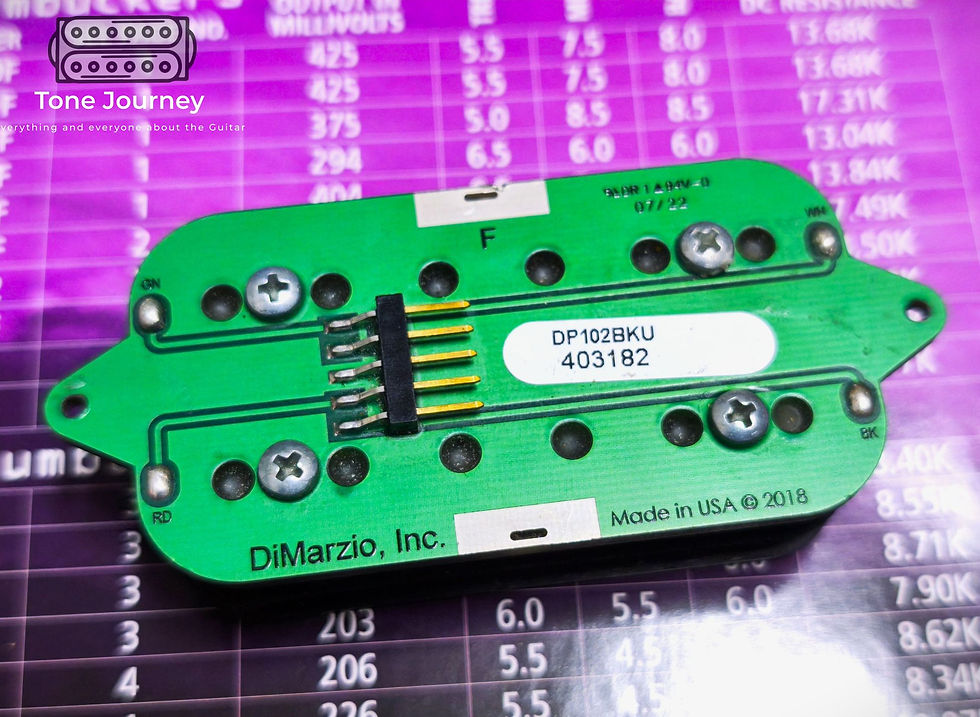
The pickup I have is a current sample, only a few years old, so it comes with a circuit-board-style baseplate and a Quick Connect connection. I really wish all the other pickups I've bought since then had used this system as well. I could have saved at least 5–10 minutes every time I swapped a pickup, anyway. I also think these baseplates look very cool. They give the pickup a distinctly modern appearance.
There is one more thing I want to point out here, and this is where I’m going to connect things back to my experience with Chuck, which I mentioned in the introduction section. The DCR specification of the X2N seems to have changed somewhat over the years. The earliest catalog value I could find lists it at 14.50K ohms, while the current catalog specification is 15.83K. Okay. But what about the EQ figures? The earliest values I could find—and the ones listed up until around the beginning of the 2000s—are the same: 5/5/7 (Bass/Mid/Treble). During the 2000s, the DCR specification remained the same, but the EQ figures changed to 5.5/6.5/6.5. That seems like a reasonably subtle refinement. Nothing particularly dramatic. But then we get to the current EQ figures: 9/8.5/8.5/3.5. And this is where things get interesting.
Does this mean that the older X2Ns really were relatively flat in the bass and mids, with considerably more treble? If so, could that actually explain the impression I got from Chuck's Death tones all those years ago? Or are we simply looking at a change in the way DiMarzio presents or calculates its EQ specifications today?
I honestly don't know. I would need to get my hands on an older X2N and measure and hear it myself to say anything with confidence. That said, if the older models also had an inductance somewhere around the 10H mark, I have a hard time believing they could actually sound that bright (PS: i have found a very old adv (look below) and it says its around 10Hs but there is no measurement frequecy info btw). Interesting stuff, and definitely something worth brainstorming about, don't you think?

Construction & Three Generations of the X2N
Visually, we can actually see three distinct eras of the X2N. The first-generation example has square-shaped mounting ears. Considering the production date, this makes perfect sense: we’re talking about a pickup that dates back to the late 1970s. In fact, the model was originally introduced in 1979, and early advertising referred to it as the X2-N Power Plus. Interestingly, the baseplate on this early version is made of nickel silver rather than brass. The bobbins also have those tiny little holes at their ends—another nice little detail that gives these early examples a very distinct appearance. They are not F-Spaced as far as i remember.
Then we get to the second era. The baseplate changes to brass, and the pickup cable is attached to the baseplate with a baseplate screw. Catalog data is all but the same, of course, but these small construction changes make it surprisingly easy to distinguish the generation you're looking at.
X2N Nickel Silver Baseplate X2N Brass Baseplate X2N Nickel Silver Baseplate w triangle ears
Finally, we arrive at the modern version—the one I have here—with its circuit-board-style baseplate and plug-in Quick Connect system. DiMarzio currently offers PCB bases with plug-in connectors on many of its full-size humbuckers, making pickup swaps considerably easier. Great option but all the recent X2Ns i have ever seen had PCBs hence i’m not sure if it is an option or standard for X2N.
Thus, how would I describe the X2N tonally? First of all, I find it much closer to DiMarzio's current official EQ curve than to the older EQ figures I mentioned above. In other words, I don't think those old EQ numbers really tell the story of the pickup I have in front of me. And this actually makes quite a lot of sense when we look at the electrical characteristics. A pickup with an inductance of more than 10H and a self-resonant frequency of around 3.70 kHz isn't exactly going to give us an abundance of sparkling high frequencies. Once the volume and tone pots, cable capacitance, and the rest of the circuit are taken into account, we can reasonably expect that resonance to shift considerably lower—potentially into roughly the 1–2 kHz region depending on the load.
The low end is, unsurprisingly, quite substantial. It's big, full and plentiful. On the other hand lows are not tight or sharp. Rounder/Smoother than you might expect from a ceramic humbucker probably thanks to huge iron mass as an influencer of eddy currents. And, as you can probably guess from the resonant frequency, there is plenty of midrange as well. In fact, if we could see the Bode plot of this pickup, I suspect we wouldn't see a particularly sharp, pronounced peak. Instead, I would expect something closer to a broad, relatively flat curve through the lows and mids, followed by a fairly steep drop as we approach the high/treble region. And that is pretty much what I hear from the X2N: a huge, dense low end, plenty of midrange, and a treble response that doesn't exactly stick around to the party. In a certain “in-your-face” mood.
Of course, a pickup's character doesn't come solely from its EQ values. If it did, as you can see in the image below, the X2N and the AT-1 would sound almost identical, since their published EQ curves are remarkably similar. But they don't sound the same.

Dynamic Range & Compression
If we turn to dynamic range and compression, I have to say I was actually surprised. With a pickup this powerful, I was expecting something much closer to the compression of an active pickup. And... well, yes. There is definitely noticeable compression, inevitably. But it isn't nearly as much as I expected. Of course, what I have here is not a PAF clone, nor is it a 9–10K overwound PAF. We simply can't expect that kind of dynamic response from a pickup this powerful. But considering its output, I would say the X2N retains a surprisingly respectable amount of dynamics. It doesn't give you the “I don't care what you're playing or how hard or softly you're hitting the strings, you moron, I'm going to give you exactly the same sound anyway!” kind of response. :)
Its sensitivity to the volume pot is also not bad. You're obviously not getting the kind of “high output + roll the volume back and suddenly you have a pristine clean tone” behavior you can get from something like the Steve Morse Bridge model which you could do those. But the X2N does clean up within a reasonable range, and the volume pot can definitely be used to tame it and move from a more aggressive sound toward a cleaner one.
Cleans? I had absolutely no expectations fort hem to be good. But they are not bad at all. If you like the clean parts of the songs with lots of chrous and reverb, yeah, you can have them. Nevertheless X2N will never be in my top 20 list for the cleans :)
Splits and parallel wiring? I didn’t do. Why? Simply because i have many guitars to go so i don’t have to improve my test guitars tonal flexibility :) Besides i don’t use the single coil of the bridge while i use much the coil split thing with the neck humbucker. But remember the inductance and DCR values are in the region of hot Tele bridge pickups: For you to compare i give you some inductance values of Tele bridge pickups: Fender Texas Special 3.3668H, Fender Twisted Tele 4.12H, Dimarzio Twang King 3.397H, Lollar Special T 3.98H, Lollar Alnico3 4.15H, Fender Blackguard 4.103H. So you might expect something beefier than a regular bridge single coil. Hence achieving a tone with a big Texan souce wouldn’t surprise me. There lots of guys who adore the split and parallel sounds of a X2N.
One final fact about the X2N. It is absolutely the most popular pickup in the baglama players. Unrivaled, unbeatable and the most common. The second? Dimarzio Al DiMeola neck and Dimarzio Al DiMeola Bridge. Strange, right? :)
So, what kind of guitars does the X2N work best with? And what kind of players would benefit most from it? Personally, I wouldn't be inclined to use it in short-scale, mahogany-body-and-mahogany-neck guitars that already have a naturally dark or muddy tonal character. I haven't spent nearly enough time playing a Gibson 500T to make any particularly bold claims here, but I suspect it might actually work a little better in that kind of guitar. That doesn't mean I think the X2N absolutely won't work in those guitars. It certainly can. It's simply not where I would personally start.
On the other hand, if you have a 25.5" scale superstrat, you want considerably more output, but you don't want to go down the active-pickup area, then... well, you've come to the right place. You can be very happy with an X2N.

And you don't necessarily have to play brutally heavy music to enjoy it, either. The X2N can be a great choice for anyone looking for a powerful, loud and unapologetically muscular sound. You don't have to be an extreme metal player to have fun with the X2N. Thus strangely enough, X2N has a certain versatility. Yes, i am surprised, too. Look at the people who use or used it; Vai still uses it on his “Sticker Strat”. He used that almost all the time with Zappa. Vivian Campbell used on his Les Paul so he all heard it on “Holy Diver” album. Trey Azgaroth and Chuck used it to play really HEAVY! Larry Mitchell used it on his Ibanez 540R and his double neck Ibanez R in the early 90s. Paul Gilbert uses a lot lately. Don’t you think its range, its pallette is wide enough?

On the flip side, if clarity is absolutely essential for you, this might not be the best choice. There is no "mud hell" with the X2N. I Don't mean it, btw. Similarly, if your guitar already has a strong tonal character in the same general direction as the X2N, this part of the frequency spectrum can become a little too prominent and make it harder to find the right balance in a mix. This is why getting the pickup height right with the X2N is absolutely crucial. I normally like to keep my bridge humbuckers fairly close to the strings. With the X2N, however, I set it about a bit lower than my usual distance.
Conclusion
Well, after all these years of deliberately keeping the X2N at arm's length, I have to admit that it surprised me.
I approached it expecting a brutally high-output, heavily compressed and rather one-dimensional pickup. And yes, the X2N is powerful—very powerful. But the amount of dynamic response it retains for a pickup with this much output was probably my biggest surprise. It is compressed, inevitably, but not nearly as much as I expected. It still responds to how you play, and the volume control remains useful enough to make the pickup surprisingly manageable.
Tonally, the X2N is exactly what its electrical characteristics would lead us to expect: a huge and full low end, plenty of mids, and a treble response that isn't particularly prominent. It isn't the pickup I'd choose when maximum clarity or a highly detailed top end is the priority, but that isn't really what the X2N is about.
What surprised me more was its relative versatility. You don't have to play extreme metal to enjoy it. In the right guitar, particularly a brighter 25.5" scale superstrat, the X2N can deliver an enormous passive output without becoming the completely one-dimensional beast I had expected. But don't forget there are many players who uses X2N on their Les Pauls and live happy ever after with their X2N.
So, has the X2N completely changed my mind?
Not exactly. I still don't think extremely high-output pickups are inherently more useful than mid output ones, and the X2N isn't going to replace my favorite PAF-style pickups. But after finally spending some time with it, I can understand why it has remained so popular for so many years. The X2N is a lot more versatile than expected—and a lot more fun—than I thought it would be.
DiMarzio X2N Pros & Cons
Pros
· Extremely high output without the extreme compression I expected.
· Huge, full and substantial low end.
· Plenty of midrange and a powerful, “in-your-face” character.
· Surprisingly respectable dynamic response for such a high-output pickup.
· Relatively useful response to the volume control.
· More versatile than its reputation might suggest.
· Particularly well suited to bright, 25.5" scale superstrats when a massive passive output is desired.
· Quick Connect system on the modern version makes pickup changes much easier.
Cons
· The low/mid-heavy character can become excessive in already dark or muddy guitars.
· Hi-end is not particularly prominent.
· Not the best choice if absolute clarity & separation and tightness are your highest priorities.
· Clean tones are usable, but hardly a reason to buy an X2N.
· Pickup height adjustment is especially important.
· There are more naturally versatile choices if maximum versatility is your priority.
Please feel free to subscribe my blog & follow my socials. So that you can support me;
Guitar pickup reviews


Comments